Joshua Barrow

This gallery contains 3 photos.

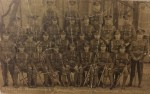
Sergt. C Sheather’s Squad – Grenadier Guards – Nov 1920 …..and so a myth is exploded – I had always thought my Grandfather Joshua Barrow served in the Coldstream Guards but this photograph puts me right – similar uniform but … Continue reading

More Galleries | Leave a comment

My parents marry

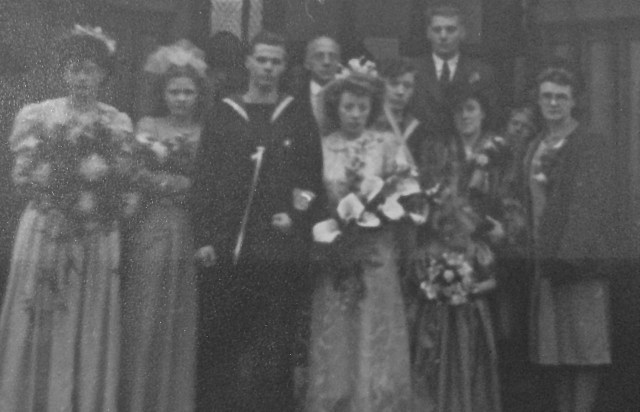
21st December 1951 and my parents are married in Ardwick, Manchester, with Charlie on release from his Naval duties.

Question:

Does anyone know why he is wearing a black shirt and not the customary white of a rating?

I’m wondering if this may be connected to the loss of a submarine north of the channel Islands in April that year. My Dad was a sparks (radio operator) during his service years and told the story that when HMS Affray went missing, he was one of the team who worked around the clock on sonar and radio to try and locate the crew trapped in the submarine but whose location could not be determined.

The official report reads as follows (Royal Navy Submarine Museum web site):

On Monday 16th April 1951 HMS Affray left Portsmouth to take part in Exercise Training Spring with a training class of young officers aboard, her orders being to make a daily report between 9 and 10 o’clock each morning and to land a party of Royal Marines on any suitable beach in the patrol area during the night. On the morning of the 17th Affray failed to report her position as required and rescue vessels were immediately put on alert as repeated attempts to call up the submarine failed. It was known that she had intended to dive 30 miles south of the Isle of Wight, so the search was concentrated off the island but the exact position of Affray was unknown. A number of vessels involved in the search reported faint Asdic signals and the submarine Ambush decoded a message stating, “WE ARE TRAPPED ON THE BOTTOM” but the Affray still could not be found. On the evening of the 19th the Admiralty regretfully called off the search. While the search for survivors was now fruitless the search for the Affray was to continue. In the middle of June, after nine weeks of searching, an underwater camera focused on the submarine’s nameplate. Her final position proved to be 37 miles from her known diving position. She was lying on an even keel on the edge of a series of underwater chasms known as Hurd’s Deep in the English Channel. Divers could find no evidence of collision damage but noted that her radar aerial and periscope were raised, indicating that she must have been submerged when she foundered. Both hydroplanes were in the rise position indicating that attempts to raise the submarine must have been in operation before being finally defeated by the incoming water. A reason for the disaster was however soon found when the snort mast was examined. A clean break was discovered 3 feet above the deck leading to the conclusion that metal fatigue had caused the loss, allowing water into the boat through a 10-inch hole. This was confirmed by tests carried out on the recovered mast at Portsmouth, all assertions as to a collision being quashed. Exactly what caused the snorkel to shear at the time it did will in all likelihood never be known.

Charlie told the story of round the clock duty and the fact that, by the end of countless shifts, the searchers were hallucinating through tiredness and repetition – but, alas, the vessel was not found and all perished. It affected him badly and on the few occasions he was prepared to talk about it, the emotion was still there after many years.

Again, a rare photograph of both sides of the family, Barrow and Mellor, together, seldom repeated afterwards as they had such different core values. This is the only record I have of both grandfathers in the same place.

After the wedding my Dad returned to active service and Mum back to Scotland to serve in the ATS. Not before the Barrows had enjoyed an undoubtedly massive booze up.

Posted in Uncategorized | Leave a comment

Albert and Ellen Mellor

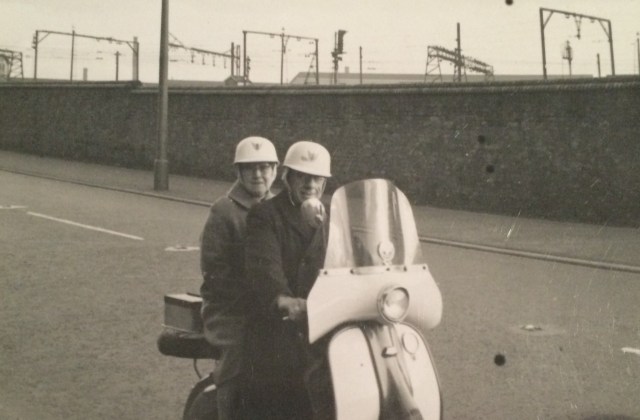
So here are Albert and Ellen, some 40+ years after yesterday’s photograph and aboard the famous Lambretta that was their special present to themselves in their later years (they never owned a car).

Gorton Road at the time is virtually unchanged from the beginning of the century, except for the arrival of overhead electrics to power new locomotives.

The age of steam is about to pass and Beeching will close 55% of the stations in the UK and 30% of the network.

Having survived Depression, War and Austerity, the railway engineering works at Ardwick Green will never recover and, within 10 years, most of this site will be closed and the houses that have supported families for over 100 years will be demolished and replaced with industrial units for wholesalers and light industry.

The miles of 19th Century terraced houses will be gone and replaced with new council housing built with materials designed to last no more than a few decades before they fall into disrepair.

The challenge for Beeching was that 80% of rail revenues came from 20% of the passengers and routes – and there was no way to make “The Long Tail” of local lines pay – so we lost our rail heritage and the passengers and goods were transferred onto the increasingly congested road network that those of you who drive now suffer every day.

Sensible economics at the time – but rather ironic that we are now investing an estimated £42.6 billion in HS2, still focused on the head of The Long Tail in 21st Century rail transport.

The railway had provided employment for the whole of Albert’s working life and even my Dad (before he joined The Royal Navy) worked as a stoker on the Manchester to Sheffield line, shovelling coal into the white-hot furnace of his steam loco as they struggled uphill out of East Manchester and through the Woodhead Pass, back and forth across the Pennines in all weathers, around the clock and the year.

For Albert and Ellen, their road adventures were to be short-lived.

In 1963, they left home one Sunday morning to cross Manchester and visit with us in Whalley Range.

As Albert emerged from a junction in Ardwick Green, their scooter was hit by a car-driver who , for some reason, just wasn’t looking and they were both thrown to the ground and hospitalised.

Although the injuries themselves were not serious, more shock that damage, they both lost their confidence as a result of the accident.

The Lambretta was sold and my primary school pick-ups became a happy memory.

Albert’s health started to deteriorate at almost the same time and, although there is no direct link, his death from pancreatic cancer the following year was a terrible blow.

I’ve already said he was my best friend when I was a small boy.

My Dad was a shift-working police constable and tried his best but couldn’t be there enough.

Albert was retired and had all the time in the world – time that he clearly enjoyed investing in time with me that I will never forget.

Yesterday I mentioned that I spent time away from home as my Mum was in hospital with psychiatric problems.

As Albert’s health declined rapidly, the decision was made to move me to live with my Uncle Bill (Mum’s brother), his wife Ruth an only son David – in Macclesfield.

Bill, Ruth and David often accompanied us on those long treks to Cornwall in August and David and I were good friends.

Many is the weekend that we would wander the hills above “Macc”, looking for abandoned quarries as David began a passion for the study of rocks that continued through his school life and University, until he became a professional geologist.

I was kept in Macclesfield while Albert continued his swift decline and passing, my Mum in Crumpsall Hospital and my Dad pulling shifts for Greater Manchester Police.

One Sunday morning I was woken by Ruth with the news that “your granddad has passed away”.

That was it.

And for the first (but not the last) time I had to face loss and grief – alone.

Posted in Uncategorized | Leave a comment

Ellen Mellor

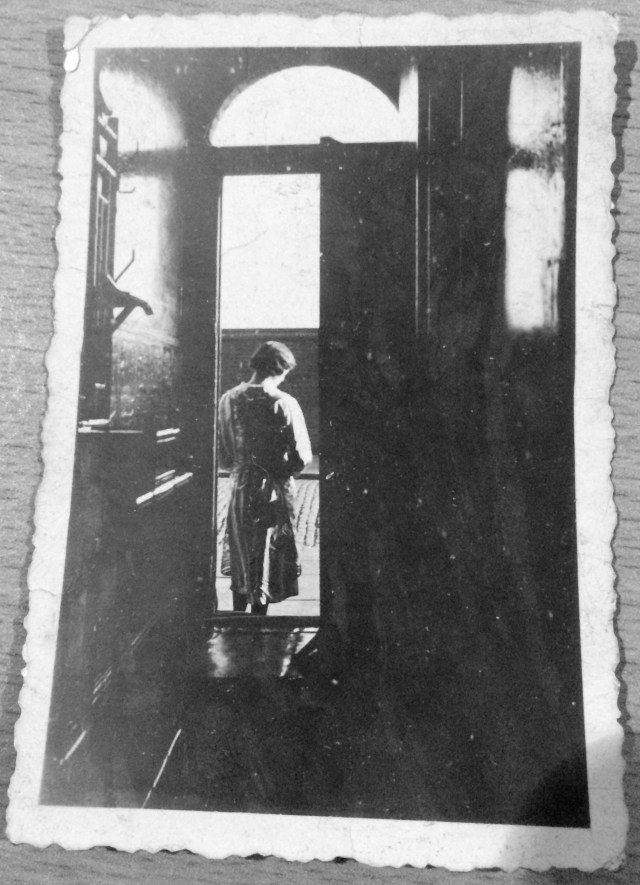
My maternal grandmother Ellen Mellor is standing at the front door of their terraced house on Gorton Road, Ashton-under-Lyne, Manchester, sometime in the 1920’s.

Husband Albert has taken the photograph.

Outside you can see the cobbled street and a large brick wall that was still standing when I visited them in the 60’s.

On the other side of the wall is Ardwick Junction – one of the largest railway sidings in the country.

As a child I would sit for hours in the front upstairs bedroom of this “two up, two down” property, watching row upon row of wagons being shunted from one siding to another, hitched onto coal-fired locomotives that would export Manchester’s engineering products all over the UK and beyond.

I remember the sound of those magnificent engines, the screech of iron wheels on iron tracks and the billowing clouds of steam that enveloped the house.

Back here in the 20’s you can see a Victorian hatstand in the hallway. To the right was the “front parlour”, always immaculate with a couple of chairs and a small table, plus a cabinet full of pottery. This room was rarely used – special occasions only and children not allowed.

I ponder at the context of this photograph – is Ellen having a conversation with a child outside the door (perhaps my uncle or mother) or simply deep in thought and the moment captured by a devoted husband?

She told the story of standing at this same spot in the early 1940’s, when the railway sidings were a regular Blitz target and watching as a parachute bomb silently passed above them, left to right, following the line of the street to land and explode 200 metres further down from their home and demolish a whole block of homes.

During the Blitz, with the children away in Blackpool, Albert and Ellen would sit under their dining table until the raids were over – the back yard wasn’t big enough to accommodate a shelter and there were no other places for the community to “hide”, other than in their homes. Albert built an iron top and legs for the table during the war, in the hope that this would protect them should the house fall down on them. Happily his engineering ingenuity was never put to the test.

There are no winners in the game of war. I’m sure my many friends across Europe have similar photographs from their family archives and can tell equally if not more frightening stories about bombs dropping on civilians and the devastation caused by men seeking power.

Having recently read Kate Atkinson’s “Life after Life” I can appreciate the terror of these campaigns on both sides of the conflict.

When this picture was taken, the Great War was a memory and the trials and tribulations of the rest of the 20th Century, depression, war and austerity, were yet to evolve.

They lived in this same home until the mid 60’s.

I lived there with them for a time when my Mum was hospitalised after a nervous breakdown in the early 60’s.

Posted in Uncategorized | Leave a comment

Joshua Barrow – Snr. & Jnr.

This gallery contains 2 photos.

Christmas letters #10 Joshua Barrow – my grandfather c. 1957 Joshua Barrow – my son 2014

More Galleries | Leave a comment

My grandfather

This gallery contains 5 photos.

Christmas letters #9 My maternal grandfather, Albert Mellor – my best friend when I was a very young boy. He was a tea-total railway engineer with a passion for sketching and oils. The painting above is the only actual piece … Continue reading

More Galleries | Leave a comment

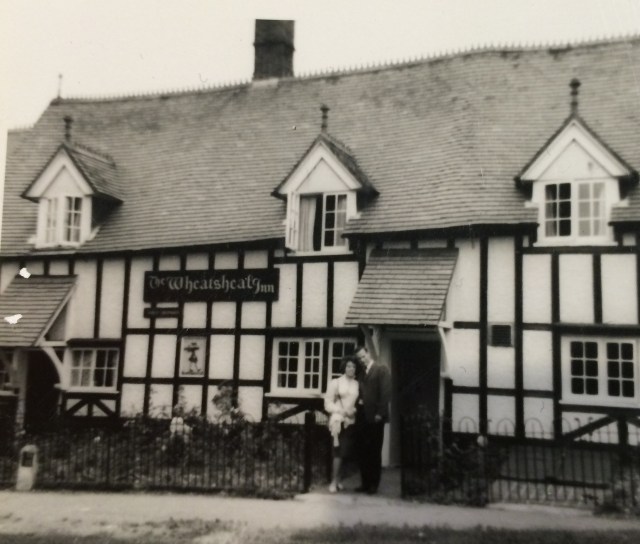
The Wheatsheaf

Christmas letters #8

The Wheatsheaf Inn, East Hendred, Oxfordshire was owned for 3 generations by the Mulford family, related by marriage to my paternal grandmother May Barrow (before marriage her name was May Day!).

The Mulford family were very close to Joshua and May Barrow and could well have offered a port in a storm when Joshua took May as his wife, along with her baby daughter, born out of wedlock to a travelling salesman who just kept travelling.

My Dad didn’t know that his elder sister Dolly was, in reality, a half-sister, until 1968 when Joshua died and May revealed the “secret” to her 4 other children and the rest of the family. I remember well the day that the revelation was made at our family dinner table and the look of complete astonishment on my parent’s faces.

May smiled a sardonic smile as she told the story of her earlier life for the first time.

Having said that, her facial expressions were always unusual because she suffered from a permanent twitch in her right eye, the result of an unfortunate encounter with a pet budgerigar in the 50’s (you couldn’t write that as a script and get away with it could you?). So as she spoke to us the right side of her face was constantly animated as her eye twitched open and closed and her cheek lifted up and down like a mad version of the Popeye cartoons we loved.

Back to The Wheatsheaf – here, Norma and Charlie are on a return visit in the early 60’s (I suspect I took the photo on a Box Brownie) to the place that my Dad was evacuated to from Manchester at the beginning of the WW2.

Charlie would have been about 12 years old at the outbreak of war, Norma 10. When the bombs started to drop, he was lucky to travel south and stay with relatives in an idyllic English village. He told us of long hot summers spent wandering the lanes around this beautiful area.

She and her elder brother William weren’t so lucky and boarded a train to Blackpool where they lodged with a variety of stern sea-side landladies until it was safe to go home.

We tend to forget nowadays how traumatic it must have been for those working class children who were simply packed up and transported off to places they had never heard of, to live with adults they didn’t know.

Before I was born, the relationship with The Mulfords was closer and members of the Northern tribe would regularly travel down and stay over (the beer may have had something to do with it).

I was lucky enough to visit The Wheatsheaf a couple of times as a child – I remember an orchard behind the pub, sleeping under exposed beams and retracing my father’s long childhood walks with him. I also remember an impressive Manor House and a home that was lived in by Cabinet Minister Roy Jenkins.

The Wheatsheaf is still an active public house and the village is now a very desirable location for the rich:

http://www.wheatsheafeasthendred.co.uk/about-the-wheatsheaf/

Posted in Uncategorized | Leave a comment

The Austin A35

Christmas letters #7

The Austin A35.

That car did some miles.

I’m dating this photo of my Dad to the mid 60’s – during one of our many holidays to Cornwall.

In the front, my Mum and Dad (him driving, she never learned).

In the back, me and my maternal grandmother Ellen Mellor, who had become a widow in 1964 and subsequently became my/our constant fellow passenger, with an endless supply of Murray Mints and vigorously clutching her Rosary and muttering “Hail Mary mother of grace” and other mysterious latin phrases under her breath as my Dad navigated the perilous highways and byways of Britain.

Between us and around us, luggage, bread, various cold meats and soft drinks for “the journey”. Somehow in that minuscule boot, enough clothing and toiletries for a 2-week holiday and no doubt some books and comics for me.

I was brought up in the Church of England and the sound of my Nana mouthing Catholic mantras was intimidating at one level (was she part of some greater conspiracy?) and confusing at another (who was this “Grace” and why wasn’t she mentioned by our lot?).

One has to put these journeys into context in the pre-motorway era.

Manchester to Newquay would be an annual pilgrimage in August and our journey would inevitably commence around 05:00 in the morning (so as to beat the worst of the traffic).

I retain vivid memories of being hauled out of bed at 04:00, downing milk and toast and then setting off and travelling through Knutsford and on down to Holmes Chapel, Stoke, Stafford, Birmingham, watching the sun rise over the mist-covered fields of Cheshire.

As the day wore on we would join the madding throng heading for the South West and, by mid-afternoon, we would be navigating our way through Bristol and heading further south to Bridgwater where, in the absence of an M5 link to Exeter, we would turn sharp right and work our way across Somerset and on to the North Coast of Devon to do battle with endless caravans struggling to climb the hills of that beautiful county.

Stops for a lay-by lunch, hopefully with a cafe from which we could buy tea (always tea, never coffee) and some kind of cakes to supplement our basic nutrition.

Minehead, Ilfracombe, Barnstaple and Bude, onward, ever onward, an endless single-lane queue of similarly frustrated families, caravans eventually pulling off into fields, until we glimpsed Bedruthan Steps against a setting sun and arrived at our guest house or rented cottage.

On average a journey to Mawgan Porth (our traditional destination year after year) could take 12-15 hours of driving and we would all arrive exhausted, my Dad sometimes hallucinating from fatigue and reading Morse Code messages in the throbbing and clanking of pistons and crankshaft.

Arrive hopefully in time to be shown to our room/rental and in time for “tea” with the similarly bedraggled guests or in time to swoop down into the village and pick up the biggest stash of fish and chips imaginable as a reward for our endeavours.

What followed would be two weeks of glorious sunshine or thunderous rain – there never seemed to be a half-way house.

In the sunny fortnights we would spend every day on the beach, in and out of the waves with belly-boards, exploring the cliffs and rock pools, both of my parents steadily blistering in the sun – no oils or potions to help – I remember spending one summer holiday with a huge festering burn on my shoulder – another when my Dad spent 3 days in bed, his back a mass of blisters.

Somehow Norma always managed to keep herself in the sun just long enough to avoid permanent damage. She knew that the height of neighbourhood status would be to return at the end of the month with a “suntan” – which in the case of a ginger-haired lady and her son (me) simply meant looking like a letter-box with teeth.

Other times it rained – and rained and rained. After a succession of trips to historic piles of rock, fishing villages and amusements we would usually give up after a week and make the long drive back to Manchester to avoid the relentless downpour.

My Dad would announce “I’d rather watch telly at home” and we would forlornly pack the car, settle our bills and splash our way out of the county and back to the home comforts of chip butties and Z Cars.

2 weeks in August – that was it in those days – they were your annual holidays – and if it poured we felt cheated – not even Ellen’s mystic chants could help. We lived under the gaze of a vengeful God who would reward our year’s travails with pleasure or pain.

Through it all, that little car just kept going and going, ever faithful and reliable. Impervious to the weather, the traffic jams and our demands.

They don’t make them like that any more.

Posted in Uncategorized | Leave a comment

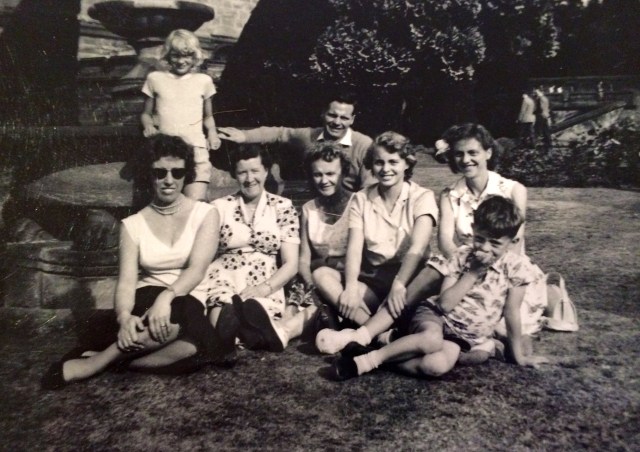
A family day out

Christmas letters #6

This, I’m guessing, is Trentham Gardens, near Stoke-on-Trent and I’ve got the date around the very early 60’s.

What is unusual about the photograph is the both of my grandmothers appear together, a very rare sight as they had zero in common.

From the right of the photo as you see it:

  • there is lovely little me in the front, clearly thinking up some mischief;
  • behind my, my Dad’s sister Ethel (one of 5 siblings);
  • Ethel’s oldest daughter Jean;
  • at the back, my Dad Charlie Barrow;
  • in front of him, his mother May Barrow;
  • beside her, my maternal grandmother Ellen Mellor;
  • My Mum Norma Barrow;
  • behind her, Ethel’s younger daughter Audrey

The differences in clothing between the older and younger women indicates the transition from post-War working class austerity to a more modern outlook – and, of course, the growing influence of American TV as my Mum tries her best to look like Manchester’s answer to Gina Lollobrigida.

I’m not at all sure where all the men-folk are in this picture, let alone my Dad’s 3 other siblings and the many cousins I spent my youth with.

At Easter every year, there would be a day’s expedition by car to a nearby beauty spot – in these days before motorways were open, Manchester to Stoke (30 miles) was quite enough and it was normal for a convoy to set off from Joshua and May Barrow’s house in Wythenshawe, with plenty of food and drink on board to last the whole day.

As I mentioned, unusual for the two Grans to be out together, which makes me wonder if this trip included Ellen Mellor following the demise of my grandfather Albert, or whether there is some simpler explanation.

Albert and Ellen were strict tea-totalers, he a Methodist and she a devout Catholic who had wed against the tide of opinion in the 20’s but lived a very quiet and sober life in a small terraced house in Gorton, East Manchester.

The Barrows, however, were known carousers (hmm……) and the whole family would gather regularly on a Saturday night to play cribbage, smoke and drink until the early hours.

My cousins and I would have the run of the rest of the house, plenty of lemonade and crisps and imagine ourselves into numerous adventures as the grown-ups laughed, sang and sometimes danced downstairs.

As an only child (violins out) I was very solitary and had few friends at school or in our neighbourhood (Whalley Range). My father by this time was a serving police officer and kept himself very much to himself in the locality – so the cousins were my social life and, as one of the youngest, I was always looked after well.

As well as trying to look like a starlet, my Mum’s behaviour matched that of problem celebrity when she had “had a few” – her ability to get drunk quickly and cause chaos was legendary and many were the nights when she would end her evening with outrageous acts of attention-seeking, including throwing her wedding ring down the street (cue car headlights in the fog), flirting with every man in the room and, usually, collapsing unconscious (to the relief of all), to be dumped in a spare bedroom until going home time.

For all that, my parents both treated me well and with love – I had a privileged childhood, given our relatively poor economics and they both tried their level best to give me a good upbringing and education.

My solitary existence at home gave rise to an early love of reading that has paid me back a thousand-fold over the years.

When she was sober (which was the majority of the time) my mother also taught me to debate – of which more later.

However, as this photograph is taken, there are darkening clouds on the horizon – Norma has been to see her GP to ask for the new “slimming pills” that young mothers are taking to keep their trim figures – and she is slowly and inexorably becoming addicted to barbiturates – the consequences of which will reverberate around our household and the family.

For now though – a happy and simple day in the Spring sunshine.

Posted in Uncategorized | Leave a comment

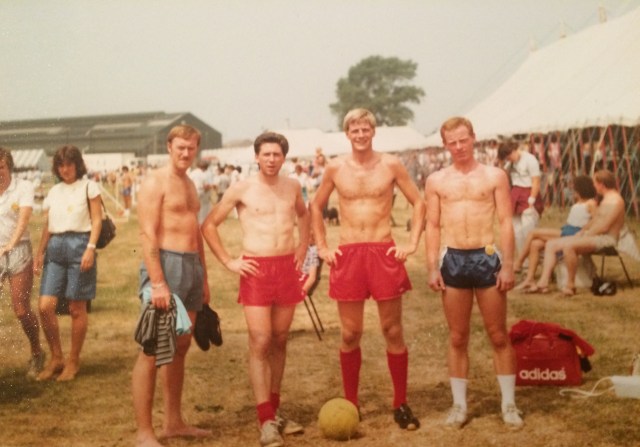
The footballer

Christmas letters #5

Check out the shorts!

Summer 1984 (I think) and we are in sunny Swindon, Wiltshire for the Hambro Life Assurance annual 5-a-side football tournament, with teams from branches of the company all over the UK.

Next to me is my then manager Gabriel (Gabs) Crayford and fellow broker consultant Andy Lee – I simply cannot remember the name of the 4th person in the line up (Phil?).

Note that I don’t have a hair out of place 😉

Due to a mix up, we arrived without our football strip and managed to borrow some shirts that were the Argentinian national colours.

So soon after The Falklands, we were booed through every game we played and the referees allowed us to get kicked black and blue.

I seem to recall us making the final stages of the competition, only to be beaten on a penalty-shoot out after I missed my shot (to the delight of those watching) – an early encouragement to pursue fewer team sports and concentrate on my solo career (although my first marathon was still 13 years away).

Having said that, it was shortly after this that I began 10 years of weekly volleyball – even now the most enjoyable team event I ever took part in.

Back to the photo – not sure what became of Gabs (Facebook help here?) but I see Andy now and then and enjoyed a good old chat with him and his daughter (who run an independent financial planning practice together) during a train journey from Euston to Wilmslow a few months ago.

I was between marriages 1 and 2 at this time and Gabs and his wife Barbara even invited me on holiday to Spain with them and his brother – a random act of managerial kindness I will always be grateful for, much to eat and drink on the beach and some excellent days playing tennis until we dropped.

Posted in Uncategorized | Leave a comment